
Diving Technology Beyond Gear: Connecting Learning, Operations, and People
A diver completes a booking form, then answers the same questions at reception. An instructor searches a message thread for a student’s course progress. A team preparing tomorrow’s boat discovers that important medical documentation still needs follow-up.
These moments reveal a common problem: information collected at one stage of the diving experience does not always reach the people who need it next. The result is extra work, uncertainty, and less time for preparation, teaching, and personal attention.
The industry has long embraced equipment that improves life underwater, from reliable regulators and dive computers to exposure protection and gas analysis. Yet many of the systems supporting the experience on the surface remain fragmented and manual.
The next meaningful advance in diving technology is also about continuity: helping information, learning, and communication carry through from the first enquiry to the next dive.
Diving Technology Has Moved Beyond Gear
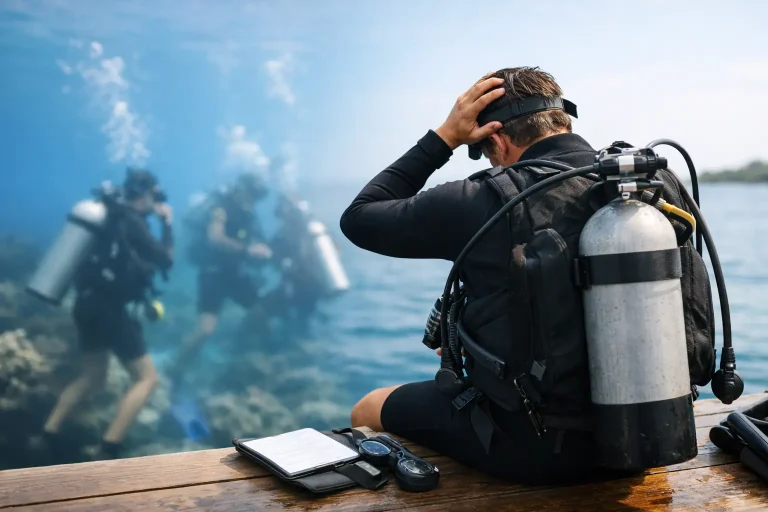
For decades, diving technology primarily meant hardware. Dive computers, integrated transmitters, rebreathers, navigation tools, and underwater cameras have changed how divers plan, monitor, and document their dives.
But a diving experience begins well before the descent. It includes discovering a center, asking questions, completing forms, accessing course materials, arranging equipment, and preparing for local conditions. Afterwards, it may continue through logging, feedback, further training, and another booking.
For a business, these interactions connect with staffing, certification workflows, equipment servicing, payments, and customer follow-up.
When each stage sits in a separate inbox, spreadsheet, paper folder, or messaging app, staff become the connection between systems. They copy information, check which version is current, and search for context that should already be available.
Digital transformation becomes useful when it reduces those gaps. A booking should support preparation. Course progress should inform the next teaching session. Relevant records should help the team deliver a consistent experience when a diver returns.
Safety Begins Before the Briefing
Preparation starts when a diver first interacts with a center. Certification details, relevant medical documentation, equipment requirements, emergency contacts, and activity prerequisites help teams identify what needs attention before the day becomes busy.
Digital intake workflows can prompt divers to complete required information before arrival and help staff identify incomplete records. Confirmation messages can explain what to bring, where to meet, and which prerequisites apply. Shared records can give authorized team members access to the information relevant to their responsibilities.
The aim is to reduce repeated administration while keeping information current. Details collected previously may still need to be verified: a diver’s health, qualifications, experience, or equipment needs can change.
Clear boundaries matter. Software cannot determine medical fitness or replace an instructor’s assessment of a diver and the conditions. It can help teams see outstanding requirements, access relevant records, and follow up before an activity proceeds.
Better information requires responsible handling
Connecting workflows also creates responsibilities around personal information, particularly when records include sensitive details.
A useful design principle is to collect information for a clear purpose and make it available only where it is needed. Someone preparing rental equipment may need sizes and configuration preferences; that does not mean they need access to a customer’s medical documentation.
Clear access controls, understandable permissions, and appropriate retention practices should be part of the workflow from the beginning. Divers should understand why information is requested and how it supports their experience.
Continuity depends on trust as much as technical integration.
Learning Does Not End With Certification
Certification marks an achievement, but knowledge needs continued use. Concepts such as pressure and volume, gas management, buoyancy, and nitrox limits can become harder to recall when divers spend time away from the water.
Short quizzes, scenario-based prompts, and spaced practice can give divers accessible ways to revisit theory. For instructors, these tools offer another channel to reinforce concepts before training, between sessions, or when preparing students for further education.
Their value depends on the connection between knowledge and practical decisions.
A nitrox calculator can help explain how oxygen fraction and a selected oxygen partial-pressure limit affect maximum operating depth. That calculation has a defined scope: it does not, by itself, assess time-dependent oxygen exposure or provide a complete dive plan.
Similarly, a physics explanation becomes more useful when it connects changing gas volume to buoyancy during descent and ascent, rather than stopping at a formula.
Used thoughtfully, digital learning gives instructors more opportunities to identify questions and misconceptions. Teaching time can then focus on explanation, application, and the direct coaching that practical diving skills require.
The connection matters: what a student reviews independently should support what happens with their instructor.
Operations Need Systems Built for Diving
Generic scheduling and customer relationship tools can support many business tasks. Diving adds requirements that often need more specific handling: certification prerequisites, equipment allocations, boat manifests, gas requirements, instructor ratios, course progress, and activity-specific documentation.
Disconnected tools leave staff to manage these relationships manually. A booking changes, but the equipment list does not. A student completes paperwork, but the instructor cannot find it. A special request stays in a conversation instead of reaching the person preparing the trip.
Purpose-built operational platforms can help connect these stages. Booking information can support preparation messages. Course records can help instructors see progress and outstanding tasks. Equipment and roster views can give staff the details needed for their work.
This is the principle behind Millibar’s approach to the Diving Experience Manager: reduce repetitive coordination and preserve context across the customer journey, while keeping the dive center in control of its relationships.
The benefit should be visible in everyday work: fewer repeated questions, clearer handovers, and more time for teaching, guiding, and personal service.
Automation needs clear boundaries
Reminders, confirmations, and incomplete-form alerts are useful candidates for automation because they follow predictable rules. Even then, teams need to know whether messages were delivered, whether customers responded, and which issues remain unresolved.
Other situations require direct attention. A medical question, a changing forecast, a last-minute site decision, or a diver expressing anxiety should reach an appropriate person.
AI assistants can help organize information, draft routine responses, or direct people to approved resources. Their usefulness depends on clear limits, reliable source material, and an easy route to human support.
Good automation makes outstanding questions visible and gives someone responsibility for resolving them.
Accessibility Belongs in the Whole Experience
A connected experience also needs to work for people with different languages, abilities, devices, and levels of digital confidence.
Clear instructions, readable text, sufficient contrast, screen-reader support, keyboard navigation, and forms with understandable error messages are practical design priorities. Captions and alternative formats can make learning materials easier to use in different settings.
These choices affect the entire journey. An accessible booking form helps a customer provide accurate information. Clear preparation messages reduce uncertainty. Well-structured learning content helps people revisit a concept at their own pace.
Mobile access alone is not enough. A form can fit on a phone and still be confusing or difficult to complete.
Dive businesses and technology providers should test complete workflows with people who have varied access needs. The useful question is whether someone can understand and complete the task, from the first interaction through to any follow-up.
Connected Tools Create More Value
Specialized tools can serve different needs well. The challenge is helping relevant information move between them responsibly.
Where appropriate, interoperability can reduce duplicate entry and make it easier for centers, instructors, and divers to use the services that suit them. Shared data models, documented interfaces, and clear permissions can support that exchange.
This is an ambition for the industry, and it requires careful decisions. Which information needs to move? Who can authorize access? How are updates handled? What happens when someone changes providers?
Not every record belongs in every system. Medical information, commercial records, and learning progress have different purposes and access requirements.
For Millibar, the broader ecosystem vision is to connect operations, learning, and diver services around these real needs. Each connection should have a clear benefit for the people using it.
Build Technology Around Better Diving
The most useful measure of diving technology is what it improves in practice: a diver arrives prepared, an instructor understands a student’s progress, or a team resolves an outstanding requirement before departure.
Those outcomes depend on continuity. Information needs to reach the next person. Learning needs to carry into practice. Automated workflows need to bring exceptions to someone’s attention.
For dive professionals, a practical starting point is the handover that repeatedly causes friction. Identify where context gets lost, improve that connection, and measure the result through preparation time, repeated questions, incomplete records, or staff workload.
The future of diving will be shaped by the equipment we trust underwater and the systems that help us prepare, learn, and work together on the surface.