What dive center management platform should do
A full boat, a stack of waivers, three last-minute course changes, a student asking about eLearning access, and an instructor trying to confirm cylinder fills before departure – this is exactly where dive center management software stops being a nice idea and starts becoming operational infrastructure.
For many dive businesses, the real problem is not a lack of effort. It is that daily operations are still spread across inboxes, paper forms, chat threads, spreadsheets, generic booking tools, and staff memory. That fragmentation creates drag everywhere: customer communication slows down, training records become harder to track, staff coordination gets messy, and avoidable mistakes start to feel normal. In an industry built on safety, timing, and trust, that is too much operational risk to accept as business as usual.
This is the direction we are building toward with Millibar’s Diving Experience Manager: an AI-driven operational platform designed around the real workflows of dive centers.
Our goal is to help operators reduce fragmentation, automate repetitive communication and administrative tasks, improve visibility across daily operations, and create a smoother experience for both teams and divers, without removing the professional judgment that diving requires.
Why dive centers outgrow generic software
Generic business tools can help for a while. A calendar app can handle bookings. A form builder can collect waivers. A CRM can store customer details. Accounting software can manage invoices. But a dive center is not a generic appointment business, and that distinction matters.
Diving operations combine logistics, education, equipment, safety procedures, certification pathways, environmental conditions, multilingual customer support, and recurring customer relationships. A discover scuba session, an Open Water course, and a technical diving charter do not have the same staffing, paperwork, risk profile, or follow-up workflow. When operators force all of that into disconnected general-purpose tools, they usually end up building workarounds rather than systems.
The cost of those workarounds is rarely obvious at first. It appears in staff time, missed upsells, slower responses, duplicate data entry, inconsistent records, and poor visibility into what is actually happening across the business. It also appears in customer experience. Guests may never see the spreadsheet chaos behind the scenes, but they feel the effects when confirmations are delayed, training materials arrive late, or check-in takes too long.
What good dive center management platform actually solves
The best dive center management software does more than digitize paperwork. It connects the parts of the business that already depend on each other.
Bookings should not sit in isolation from staffing. Course enrollments should not be detached from learning progress. Waivers should not live separately from customer profiles. Equipment planning should not rely on someone remembering what was promised in a WhatsApp message two days earlier. A capable platform creates continuity from first inquiry to post-dive follow-up.
That continuity matters for both efficiency and safety. When customer information, certification status, medical forms, trip details, and instructional context are connected, staff can make better decisions faster. The front desk, instructor team, boat crew, and management are no longer reconstructing the same customer journey from different fragments.
This is also where digital transformation in diving needs a more practical definition. It is not about adding more apps. It is about reducing operational fragmentation so the center can run with more clarity, consistency, and accountability.
The core functions dive center management software should include
A serious platform should cover the operational reality of a modern dive business.
Booking and scheduling built for diving
Dive center scheduling is rarely simple. Boats have capacity limits, instructors have certification scopes, courses span multiple sessions, and weather can disrupt everything. Software built for diving should reflect those realities rather than treating every booking as a one-hour appointment.
That means handling trips, courses, pool sessions, private guides, rental allocations, and recurring training activities in a way that staff can actually manage under pressure. It should also make rescheduling less painful. In diving, schedule changes are not edge cases. They are normal operations.
Customer records that support service and safety
A customer profile should be more than contact information. It should bring together waivers, certification details, course history, communication history, equipment preferences, participation records, and relevant safety documentation.
This is not just convenient. It supports better briefings, smoother check-in, and stronger continuity between staff members. If a student returns after a gap in training or a diver books a trip months after a course, the center should not have to start from zero.
Training workflows, not just sales workflows
Many systems handle transactions well enough but fail at education. That is a major gap in diving.
Dive centers are not only selling seats on a boat. They are delivering training, assessing readiness, tracking progression, and reinforcing safe practice. Software should support course sequencing, student communication, document handling, reminders, and learning continuity. If the system makes instruction harder, it is solving the wrong problem.
Communication automation with human judgment still in place
Automated reminders, confirmations, document requests, and follow-ups can save significant time. They can also reduce no-shows and improve preparation rates. But automation in a dive business should be designed carefully.
A reminder to bring a towel is simple. A message about prerequisites, medical requirements, or conditions-related changes requires more context. Good software helps staff automate the repetitive parts while keeping human oversight where safety and nuance matter.
Reporting that informs decisions
Most operators know they are busy or slow. Fewer have a clear picture of why.
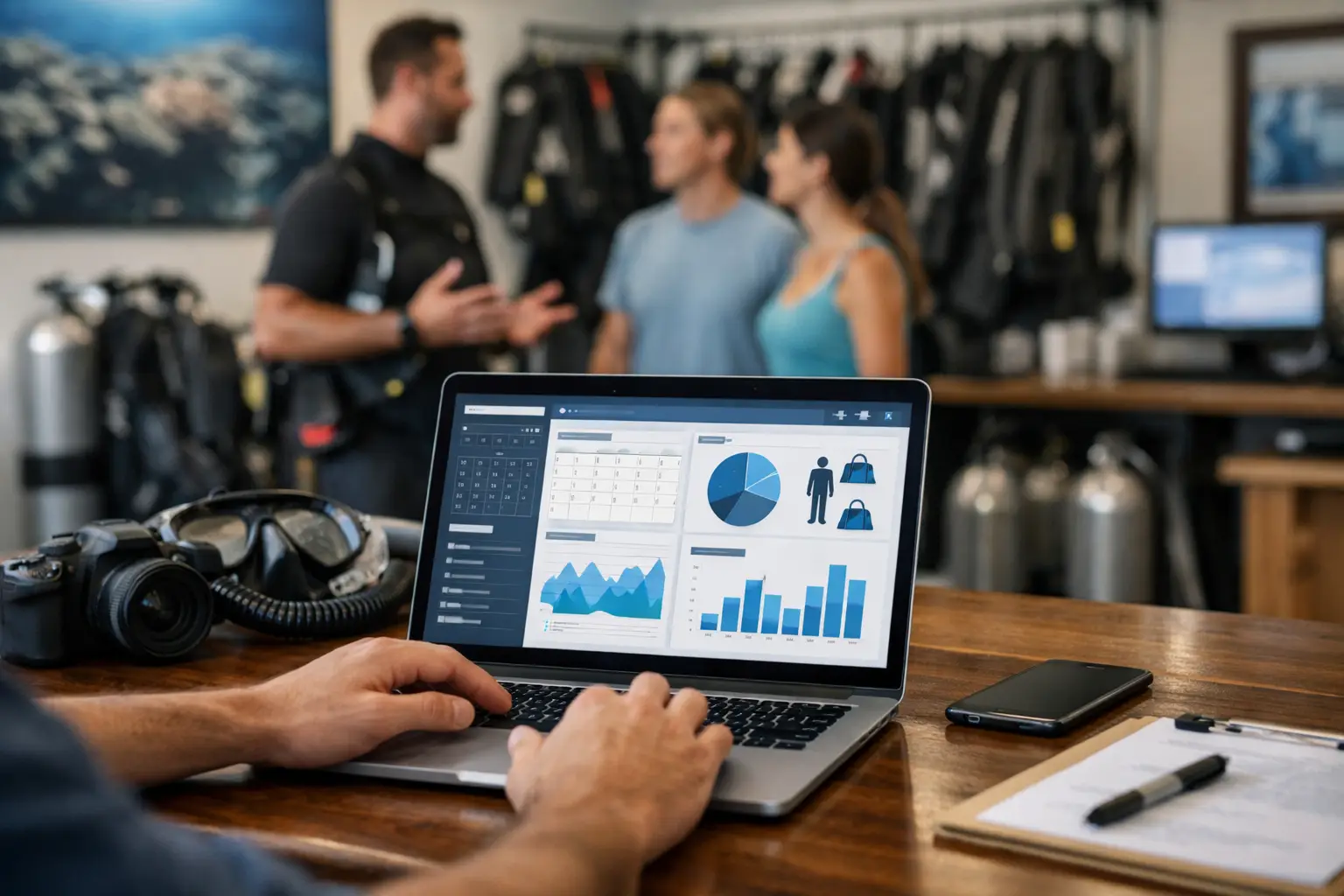
Reporting should show which activities drive revenue, where inquiries drop off, which courses convert well, how repeat customers behave, when staffing bottlenecks occur, and how operational time is being spent. Without that visibility, growth decisions are often based on instinct alone. Instinct matters, but it should not be the only management tool available.
The trade-offs operators should think about
Not every dive center needs the same level of software maturity. A small training-focused shop with one boat and a stable local audience may need something different from a multi-location operator serving tourism, retail, charters, and professional development.
That is why software selection should start with operational fit rather than feature volume. A platform with dozens of tools is not automatically better if the staff cannot use it well or if setup becomes a project the business never finishes.
There is also a real balance between flexibility and standardization. Some centers want highly customized workflows. Others need staff turnover to be less disruptive, which usually means more consistent processes and less dependence on individual habits. Software can support either approach, but not always both equally.
Implementation matters too. Bad software creates friction. Bad implementation can make even good software fail. If the team does not trust the system, keep records updated, or understand how the workflows fit together, the business will drift back toward paper notes and side-channel communication.
Why this matters beyond efficiency
The conversation around dive center management software can sound overly administrative, as if the goal is just saving time at the desk. That understates what is at stake.
Better systems can improve student preparedness, reduce communication gaps, support accessibility, and make service quality more consistent across staff and seasons. They can help centers keep stronger records, respond faster, and create a more professional experience for divers who increasingly expect digital clarity in every other part of their lives.
They also make the industry more scalable in healthier ways. A center that depends entirely on one person remembering everything is not resilient. A center with connected workflows has a better foundation for training quality, customer retention, team coordination, and long-term growth.
This is especially relevant as diving faces broader pressure to modernize. Customer expectations are changing. Educational delivery is evolving. Staff workloads remain high. Many businesses still rely on fragmented systems that were never designed for the operational complexity of dive training and trip management. Purpose-built infrastructure is no longer a luxury category.
The direction the industry should move
The future of dive center management software is not a longer list of disconnected features. It is smarter operational support.
That means systems that can reduce repetitive admin, surface useful context at the right time, support learning pathways, and strengthen communication without removing professional judgment. It also means software designed by people who understand how diving actually works – from certification logic to gear logistics to the safety culture that underpins the whole business.
We are also likely to see stronger integration between operations, education, and AI-assisted workflows. Used well, that can help centers respond faster, personalize communication, and give staff better operational visibility. Used poorly, it can create noise and distance people from the real responsibilities of instruction and care. The difference will come down to design choices and industry understanding.
This is where specialized platforms matter. Millibar’s broader view of the sector reflects a simple premise: diving needs digital tools built around diving, not adapted reluctantly from other industries after the fact.
Dive businesses do not need more software for its own sake. They need systems that respect the complexity of what they do and make that work easier to deliver well. The centers that invest in that foundation now will be better positioned not just to operate more efficiently, but to teach better, communicate better, and build stronger trust with every diver who walks through the door.