Top Ways to Modernize Dive Operations Now
A missed medical form at 6:15 a.m., a staff member searching three inboxes for a guest’s certification, and a customer who never receives the pre-trip briefing are not minor inconveniences.
They are signals of an operation carrying unnecessary risk and administrative drag.
At Millibar, our mission is to help modernize dive center operations by turning proven operational principles into a connected digital environment designed specifically for diving. Modernization should not mean adding more disconnected tools. It should mean creating simpler, more reliable ways of working.
The most effective ways to modernize dive operations start by improving the methodologies behind the moments that shape a diver’s experience: discovery, booking, preparation, the day of the dive, and follow-up.
For dive centers, modernization is not about adding technology for its own sake. It is about designing workflows that make safety information easier to access, staff time easier to protect, and customer communication more reliable. Technology should support those workflows rather than dictate them.
Start With the Diver Journey, Not the Software
A common mistake in digital transformation is to start by looking for a tool: a booking system, a CRM, a messaging solution, or a digital waiver platform. This can easily result in one more login for staff and one more disconnected source of information.
A better starting point is to map the full diver journey and identify where information is lost, repeated, delayed, or handled inconsistently.
Consider a first-time customer. They may ask a question through social media, book through a website, provide personal and certification information, complete required documents, and receive meeting details before arriving at the center. If each stage operates independently, the center has no dependable view of readiness. The diver may arrive without required forms, the correct documentation, or a clear understanding of equipment and logistics.
Map each handoff between the customer, instructor, front desk, boat crew, and back-office team. Then prioritize the gaps with the greatest safety, revenue, or workload impact.
For one operation, that may be incomplete waivers. For another, it may be customers repeatedly asking for information that should already have been communicated, or staff manually checking whether every diver is ready for the next day’s activities.
Modernization should begin by improving these processes – not by accumulating software.
Create One Reliable Operational Record
The core principle of a modern dive operation is simple: information that matters should have a clear, reliable source. A Single Source of Truth!
Staff should not need to search email threads, paper binders, personal phones, and spreadsheets to answer basic questions: is this diver certified for the trip? Has the waiver been signed? Are there medical disclosures requiring review? What rental gear has been assigned? Has payment been completed?
A connected operational record does not eliminate professional judgment. It supports it. Instructors and crew still need to assess conditions, diver capability, and the suitability of an activity on the day. But they should do so with accurate information available before the boat leaves the dock.
The same methodology applies to diver onboarding. Information should be collected in a structured way so that it can be reviewed, flagged when necessary, updated, and connected to the diver’s activities. Certification details, emergency contacts, rental history, activity history, and relevant documentation should form part of the same operational context rather than existing in isolated files.
Data quality matters as much as digitization. Establish clear ownership of records, define how information is updated, create a process for correcting duplicates, and determine which team members should have access to sensitive information.
The objective is not simply to replace paper with screens. It is to establish a dependable source of operational truth.
Make Communication Part of the Workflow
Dive centers spend significant time answering recurring practical questions: where do we meet? What should I bring? Is equipment included? Can I join this activity with my certification level? What happens if weather conditions change?
These questions deserve clear answers. But reliable communication should not depend entirely on somebody remembering to send the right message at the right moment.
Instead, communication should be designed as part of the operational workflow.
A booking confirmation should trigger the information needed to prepare for the activity. Missing documentation should be identified before check-in. Meeting instructions should arrive when they are useful. Changes affecting an activity should be communicated consistently. Follow-up should not depend on someone finding time at the end of a busy day.
This principle is at the core of improving dive center communication: information should reach people in context, rather than being scattered across channels and dependent on manual follow-up.
The important distinction is between automation and abandonment. Customers should always be able to reach a knowledgeable person when a question involves medical considerations, certification limitations, anxiety, accessibility needs, equipment fit, or changing conditions.
Automation should handle predictable logistics. People should remain responsible for judgment, reassurance, and exceptions.
The same applies to AI in dive center operations. AI can make operational information easier to access, help respond to common questions, and surface situations requiring attention. It should not independently make safety decisions or substitute for professional judgment.
In diving, useful technology makes expertise more accessible. It does not pretend expertise is unnecessary.
Turn Operational Data Into Decisions
Most dive businesses already generate significant amounts of information. The challenge is that it is often fragmented across bookings, customer records, instructor notes, spreadsheets, messages, and operational processes.
The methodology should be to turn that information into decisions.
Start with a small set of useful questions. Which activities generate the most repeat bookings? At what point do inquiries fail to convert? Which rental items create the most maintenance issues? How often are forms incomplete at check-in? Which communication reduces late arrivals?
The objective is not to create dashboards nobody checks. It is to establish a regular habit of reviewing operational signals and acting on them.
If a certain activity has high cancellation rates, investigate the booking path, scheduling assumptions, pricing, pre-trip information, and customer expectations. If a boat trip regularly departs late, determine whether the issue is staffing, check-in flow, document completion, or equipment allocation.
Data can also support safer planning. Trends in incidents, near misses, equipment defects, diver readiness concerns, and environmental conditions can reveal patterns that are difficult to identify when every event is treated in isolation.
The value comes not from collecting more data, but from connecting the information already generated by the operation and making it useful.
Design Around Real Dive Center Conditions
Digital transformation only works when the resulting processes fit the environment in which people actually work.
Many guests interact with dive centers primarily from mobile devices. Some have limited connectivity while traveling. Staff may need information at a front desk, on a dock, in an equipment area, or while coordinating activities away from the center.
Operational processes therefore need to be simple, mobile-friendly, and resilient.
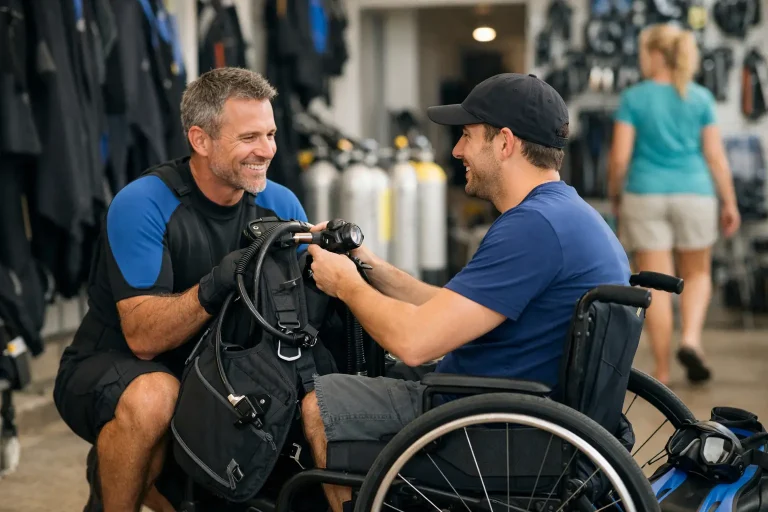
Accessibility should be considered from the beginning as well. Clear interfaces, readable information, language support, and straightforward processes benefit everyone, not only customers with specific accessibility requirements.
Technology should adapt to the realities of the dive operation rather than forcing the operation to adapt to the technology.
Improve in Phases and Measure the Change
Modernizing dive operations does not require changing everything in one season.
Large transformations often fail because too many processes change simultaneously, especially when staff are expected to adopt them during peak operational periods.
Instead, begin with one workflow that is highly repetitive, operationally important, or visibly frustrating for customers and staff.
That might be the journey from inquiry to booking. It could be diver onboarding and documentation. It might be pre-activity preparation, check-in, equipment allocation, or customer follow-up.
Define how the workflow should operate first. Then measure whether the change improves a meaningful outcome.
Useful measures might include fewer incomplete forms, reduced check-in time, fewer no-shows, faster responses, fewer repetitive customer questions, improved repeat bookings, or fewer staff hours spent chasing information.
Once the methodology works, extend the same principles to the next part of the operation.
From Better Methodologies to a Unified Operation
These principles – following the diver journey, maintaining reliable operational information, making communication part of the workflow, using data to support decisions, and improving processes incrementally – are not individual software features.
Together, they describe a more connected way of running a dive center.
This is the approach we are building into Millibar.
Rather than asking dive centers to assemble another collection of specialized tools, Millibar’s Diving Experience Manager brings these methodologies into a unified platform designed around the operational realities of diving. Our evolving AI capabilities build on the same foundation, making the information and services of a dive center easier to access without separating them from the operational context behind them.
The goal is not to put more software between dive professionals and their customers. It is to make the underlying operation work better.
The modern dive operation is not the one with the most software. It is the one where information follows the diver journey, routine processes work reliably, and staff can spend less time chasing information and more time preparing divers, managing risk, communicating with customers, and creating experiences that bring people back to the water.