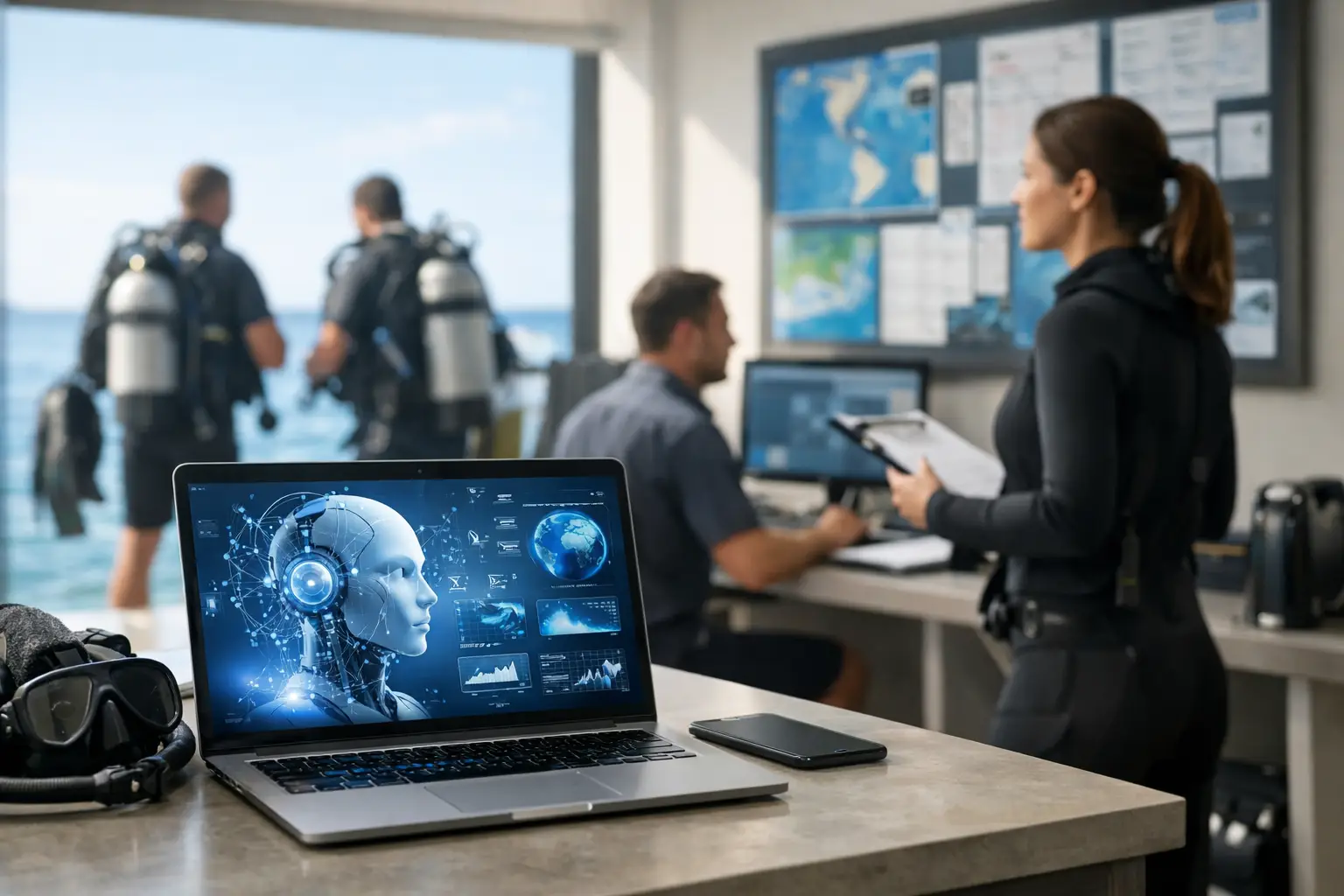
AI for Dive Center Operations That Actually Helps
AI for Dive Center Operations: From Buzzword to Infrastructure
A missed form. A late reply to a student asking about Nitrox. A boat roster updated in one spreadsheet but not in another.
This is where AI for dive center operations stops being a buzzword and starts becoming operational infrastructure.
Most dive centers are not struggling because they lack effort. They are struggling because too much critical work still depends on memory, inboxes, paper forms, disconnected tools, and processes that were never designed around the realities of diving.
At Millibar, this is exactly the problem we are addressing with our Diving Experience Manager: a purpose-built operational layer for dive centers, designed to connect bookings, communication, readiness, workflows, and customer experience in one more coherent system.
Want to hear more about how the Diving Experience Manager can support your dive center? Contact us and let’s talk.
That distinction matters.
Diving is not a generic service business with a calendar attached. A dive center has to coordinate training standards, medical declarations, gear logistics, staff schedules, boat capacity, certification pathways, customer communication, local conditions, and safety-sensitive records.
When operators hear “AI,” many immediately think of marketing automation or chatbots giving generic answers. But the more useful question is narrower and more practical:
Where can software reduce operational friction without reducing human judgment?
What AI for dive center operations should actually do
If a system adds novelty but not reliability, it does not belong in a dive business.
The best use of AI in this context is not replacing instructors, divemasters, or front-desk teams. It is supporting them by handling repeatable communication, surfacing missing information, organizing operational data, and helping staff act faster on routine tasks.
That means AI can be useful in customer messaging, course follow-up, booking workflows, document collection, lead qualification, internal knowledge access, and schedule coordination.
It can draft replies to common questions, flag incomplete student records before check-in, or remind staff that a guest booked Enriched Air training but has not submitted the required forms.
These are not glamorous features. They are the small operational improvements that protect time, reduce preventable mistakes, and make a dive business feel more reliable.
But AI only works well when the underlying process is clear.
If a center has scattered records, inconsistent naming, duplicated customer data, and no clear ownership of tasks, AI may accelerate confusion rather than solve it. Automation is not a substitute for operational discipline. It is an amplifier.
Where AI creates the most value
For most dive centers, the first win is communication.
Dive businesses spend a surprising amount of time answering repeat questions: certification prerequisites, start times, what to bring, weather policies, rental sizing, eLearning steps, pickup points, medical forms, and course requirements.
An AI-supported workflow can respond quickly, consistently, and in the tone of the business, while still escalating unusual or safety-relevant questions to staff.
The second win is pre-arrival readiness.
Many operational problems appear before a diver reaches the dock, classroom, or pool. Missing waivers, incomplete medical information, unpaid balances, unclear equipment needs, missing certification details, or unfinished eLearning can all create pressure at the worst possible moment.
AI can help identify those gaps early and trigger reminders based on the activity booked.
A Discover Scuba Diving participant needs a different communication flow than a Rescue Diver student, a certified diver joining a guided reef dive, or a technical diver asking about gas logistics. Generic automation often misses that difference. Dive-specific automation should not.
The third win is schedule awareness.
Dive center operations change constantly. Boats move. Instructors get reassigned. Course groups shift. Weather interrupts plans. Private guides are added at short notice. Equipment availability changes. A simple schedule can quickly become an operational puzzle.
AI can support staff by summarizing conflicts, suggesting next actions, and keeping customer communication aligned with the current plan.
That does not remove the need for an experienced operations lead. It gives that person better visibility when things get busy.
Then there is knowledge management, which is often overlooked.
In many centers, operational knowledge lives in people’s heads. One staff member knows how a certain training agency handles referral paperwork. Another knows the marina’s latest boarding rule. Someone else remembers which local site tends to surge with a particular wind direction.
AI can help make that knowledge easier to access internally, especially for new staff, seasonal teams, and multilingual operations.
But this only works if the information is curated, current, and connected to the actual way the center works.
What should never be fully delegated to AI
Safety-critical judgment remains human work.
That includes assessing student readiness, deciding whether conditions are appropriate, interpreting medical concerns, evaluating diver behavior, and making real-time decisions on boats and at dive sites.
AI can support documentation and information flow around those decisions. It should not become the authority.
This is especially important in training environments.
A student who technically completed the required skills may still need more time, reassurance, or remediation. An instructor sees body language, stress responses, comfort level, and performance patterns that software cannot responsibly interpret in context.
The same applies to customer communication around incidents, cancellations due to conditions, or concerns about fitness to dive. AI can help structure a message. It should not be the final voice in complex or sensitive situations.
There is also a trust issue.
Divers are usually comfortable with technology when it makes things clearer, faster, and more transparent. They become skeptical when it feels evasive, generic, or opaque.
If every answer sounds automated, or if customers cannot reach a real person when needed, the system starts damaging confidence.
In diving, confidence is not a soft metric. It affects booking decisions, learning outcomes, customer loyalty, and perceived safety culture.
Why generic AI tools often fall short
A generic CRM or off-the-shelf AI assistant can help with broad admin tasks. But dive centers usually hit limits quickly.
The problem is not that these tools are weak. It is that the diving industry has operational requirements that generic systems do not understand well.
A dive center does not just sell appointments.
It manages certification dependencies, pool and open water sequences, staff ratings, gear assignments, liability workflows, local site restrictions, trip logistics, agency-specific requirements, and recurring safety communication.
Even basic customer segmentation looks different in diving.
A newly certified diver, an inactive diver returning after years away, a Rescue student, a family booking a try dive, and a technical diver asking about gases are all “customers.” Operationally, they require very different treatment.
That is why specialized systems matter.
AI is only as useful as the structure around it. If the platform understands the logic of diver training, bookings, waivers, equipment, communication timelines, and operational readiness, AI can support the business in relevant ways.
If not, staff end up forcing dive operations into generic categories and doing the real work manually anyway.
How to adopt AI without creating new problems
The strongest approach is incremental.
Start with one operational area where the team already feels friction every day. For one center, that may be pre-course communication. For another, it may be inquiry handling, waiver collection, equipment coordination, or internal communication between instructors and admin staff.
Then measure the change in practical terms.
Did response times improve? Did fewer students arrive with missing paperwork? Did no-shows decrease? Did staff spend less time rewriting the same messages? Did the team feel more prepared before a busy day?
Good AI adoption is not measured by whether a center “uses AI.” It is measured by whether the business becomes easier to run without lowering standards.
Data quality should come early.
If customer records are duplicated, if consent practices are unclear, or if different staff members use different processes for the same task, fix that before adding more automation.
The same applies to governance. Someone needs to review workflows, check message quality, and define where human approval is required.
Training matters too.
Staff should understand what the system does, where it gets information from, and when to override it. A healthy operational culture treats AI as support infrastructure, not as a black box.
This is especially important in diving, where legal, safety, and reputational stakes are higher than in many other service sectors.
The bigger shift for dive businesses
The real opportunity in AI for dive center operations is not just efficiency.
It is maturity.
A more connected operational system helps centers communicate more clearly, serve divers more consistently, and reduce the background chaos that pulls attention away from instruction, safety, and customer experience.
This shift also has industry-level implications.
Better systems can support stronger learning reinforcement, cleaner records, more consistent follow-up after training, and better access to information for divers and staff. They can help smaller operators compete more effectively without asking already stretched teams to absorb endless administrative load.
They can also create the foundation for future tools, from educational support to operational forecasting.
At Millibar, this is the direction that matters most: not AI as spectacle, but AI as part of a purpose-built digital foundation for diving.
This is also why we are building the Diving Experience Manager: to help dive centers reduce repetitive friction, improve communication, and manage daily operations with tools designed around the realities of diving.
The centers that benefit first will not necessarily be the largest or the most experimental. They will be the ones willing to identify repetitive friction, improve the process behind it, and choose technology that respects how dive operations actually work.
That is a practical place to start.
And in this industry, practical change is often the kind that lasts.
Want to hear more about how the Diving Experience Manager can support your dive center? Contact us and let’s talk.