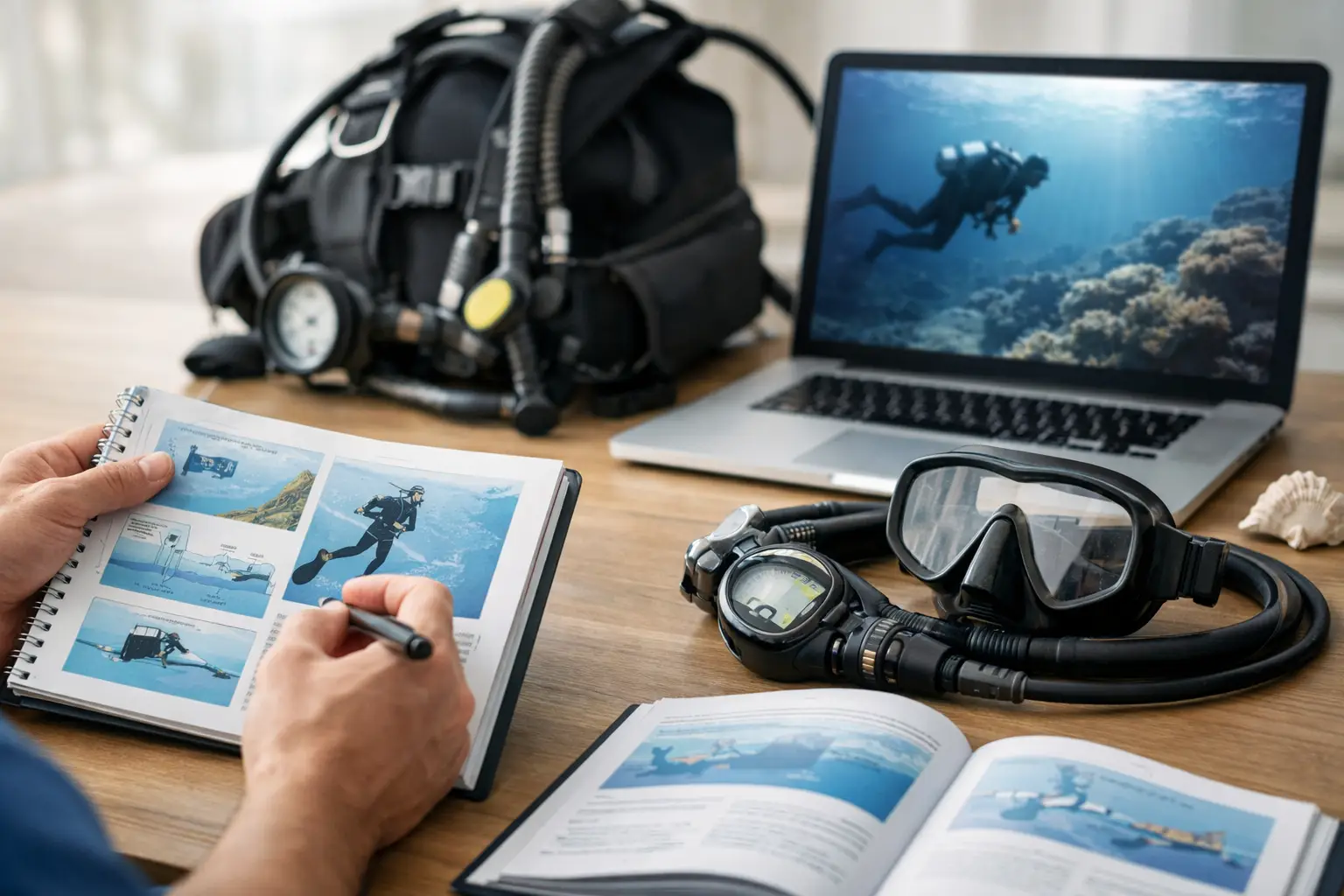
How to Remember Scuba Theory Better
Most divers do not struggle with scuba theory because the material is too complex. They struggle because they try to memorize isolated facts a few days before class or an exam. If you are wondering how to remember scuba theory, the answer is usually not studying harder. It is studying in a way that matches how divers actually build long-term recall under pressure.
That distinction matters. Scuba theory is not trivia. It is the knowledge framework behind gas management, buoyancy, decompression awareness, equipment use, and emergency decision-making. If the information disappears the moment the quiz ends, it has limited value when conditions change underwater.
Why scuba theory is hard to remember
Scuba training asks new divers to absorb several different kinds of information at once. Some concepts are mathematical, like pressure-volume relationships and depth calculations. Others are procedural, like pre-dive checks or ascent rates. Others depend on cause and effect, such as what happens to air spaces during descent and ascent.
That mix is exactly why cramming fails. Facts learned in isolation are easy to forget, especially when a student has not yet connected them to actual dives. A learner might remember that pressure increases with depth, for example, but not immediately connect that principle to ear equalization, buoyancy shifts, air consumption, and cylinder readings. Until those links are built, the knowledge stays fragile.
There is also a second challenge that instructors know well. Many students study theory as if the goal is passing a course. In reality, the goal is usable understanding. The brain retains information better when it feels relevant, repeated, and applied. Scuba theory becomes easier to remember when you stop treating it as a textbook subject and start treating it as operational knowledge.
How to remember scuba theory through context
The fastest way to improve recall is to attach every concept to a real diving situation. If you are reviewing Boyle’s Law, do not leave it as a formula. Connect it to mask squeeze, lung overexpansion risk, and why you never hold your breath. If you are studying nitrogen absorption, connect it to bottom time, surface intervals, and why repetitive dives need planning.
This approach works because memory strengthens when information has multiple retrieval paths. A formula alone is one path. A formula tied to a dive briefing, a gear setup, and a real underwater consequence becomes several paths.
For instructors and dive centers, this is more than a teaching style preference. It has direct safety implications. Students retain theory better when classroom content mirrors operational reality. That means shorter explanations, clearer scenarios, and repeated use of the same concept in different contexts rather than one long lecture followed by a single quiz.
Build mental links, not separate chapters
Many students mentally file physics, physiology, equipment, and planning as separate topics. That is neat for a workbook, but it is not how diving works. Underwater, these systems interact constantly.
A more effective method is to ask one question whenever you study: where does this show up on an actual dive? Take buoyancy, for instance. It is linked to weighting, exposure suit compression, breathing control, depth changes, and gas consumption. The more cross-connections you notice, the easier recall becomes because the material starts behaving like a network rather than a stack of disconnected notes.
Use retrieval, not rereading
One of the least efficient ways to study scuba theory is reading the same pages over and over. It feels productive because the material looks familiar. Familiarity is not the same as recall.
A better strategy is retrieval practice. Close the book or app and try to explain the concept from memory. Write down what happens to air volume during ascent. Sketch how pressure changes with depth. Talk through what to do if you feel ear discomfort on descent. When you cannot retrieve something clearly, then review it.
That small shift changes the learning process. Instead of recognizing information, you practice producing it. That is much closer to what divers need in the field, where there is no chapter page available at 60 feet.
If you want a practical rhythm, study one short topic, pause, and then explain it in your own words without looking. Keep the explanation plain. If you can teach it simply, you probably understand it well enough to remember it.
Spaced repetition beats one long session
If there is one method that consistently improves how to remember scuba theory, it is spaced repetition. Review the same concepts several times over days or weeks instead of once in a long sitting.
This is especially useful in diver education because theory often competes with work schedules, travel planning, confined water sessions, and general life logistics. A 15-minute review done repeatedly is usually more effective than a two-hour cram session before pool training.
A simple pattern works well. Review new material the same day, then again the next day, then a few days later, then a week later. Each session can be brief. What matters is the timing. Every successful recall tells the brain the information is still worth keeping.
Digital learning tools are particularly strong here because they can structure repetition without adding administrative overhead for instructors or dive centers. Well-designed quiz systems and review prompts help learners return to weak areas before forgetting becomes complete.
Turn formulas into usable memory
Scuba theory includes enough numbers to intimidate people who do not see themselves as math-focused learners. Usually, the issue is not the math itself. It is the lack of a practical anchor.
Take formulas in small pieces. First understand what the variables mean physically, then what changes in a real dive, then how the formula helps you estimate or decide. A student who understands that greater depth increases pressure and affects gas volume already has the operational logic. The equation simply makes it measurable.
It also helps to keep a few reference examples in memory instead of trying to memorize every possible variation. If you know what happens at the surface, at 33 feet in seawater, and during ascent from depth, many other calculations become easier to reconstruct. In other words, remember patterns first and exact arithmetic second.
Learn with questions, not just answers
Strong recall often comes from asking better questions. Instead of memorizing that a rapid ascent is dangerous, ask why. Instead of memorizing that equalization should happen early and often, ask what changes in the air spaces make that necessary.
Questions create structure. They force the brain to organize information around logic rather than wording. That matters because exam questions, instructor explanations, and real-world conditions will not always use the same phrasing.
This is also where short, frequent knowledge checks outperform passive study. A mobile-first quiz tool like Quest can support this style of learning because it encourages repeated recall in small sessions rather than one-time exposure. For adult learners and working instructors, that is often the difference between temporary recognition and dependable retention.
Match study methods to the type of theory
Not all scuba theory should be studied the same way. Physics concepts often benefit from diagrams and worked examples. Physiology is easier to remember through body-based cause and effect. Procedures improve through sequence practice and verbal walkthroughs.
If a concept feels slippery, the problem may not be your ability. It may be a mismatch between the content and the study method. A table might help with no-decompression planning, while a spoken explanation might work better for gas expansion injuries. Good learning design recognizes these differences instead of forcing every topic into the same format.
For dive educators and operators, this is worth paying attention to. Better memory is not only the student’s responsibility. It is also shaped by how theory is delivered, reinforced, and revisited across the training journey.
What to do when you keep forgetting
Forgetting is not failure. It is feedback. If a concept disappears quickly, it usually means one of three things: you reviewed it only once, you never applied it, or you learned the words without the underlying model.
When that happens, slow down and rebuild the concept from a real scenario. If decompression theory feels abstract, tie it to multi-day diving, ascent behavior, and tissue loading over time. If equipment knowledge feels vague, handle the gear while reviewing the terms. Recall improves when the information becomes concrete.
It also helps to be honest about cognitive load. New divers are often balancing excitement, anxiety, logistics, unfamiliar gear, and performance pressure. Memory suffers when everything arrives at once. Shorter study blocks, cleaner explanations, and deliberate repetition are not signs of weakness. They are signs of effective training design.
How to remember scuba theory for the long term
Long-term retention comes from keeping theory alive after certification. The divers who remember more are usually the ones who revisit concepts between trips, review before deeper or more challenging dives, and treat theory as part of ongoing competence rather than a course requirement they already completed.
That mindset is healthy for individual divers and essential for the industry. Safer, more confident diving depends on knowledge that stays accessible beyond the classroom. As diver education becomes more digital, there is a real opportunity to design learning experiences that support memory over time, not just completion in the moment.
The goal is not to recite a manual underwater. The goal is to build understanding that stays available when conditions change, when decisions matter, and when good theory quietly supports good judgment.