How Can AI Help Dive Instructors?
A student messages at 10:47 p.m. asking whether Dalton’s law will be on tomorrow’s exam, another forgot their eLearning login, and the morning boat manifest still needs to be confirmed. For many professionals, the question is no longer how can AI help dive instructors in theory. It is whether AI can reduce friction without weakening standards, safety, or the instructor-student relationship that makes diving education work.
The short answer is yes, but only if the industry uses it with discipline. AI is most useful when it supports preparation, reinforcement, communication, and operational consistency. It is far less useful when people expect it to replace instructional judgment, in-water supervision, or agency standards. That distinction matters.
How can AI help dive instructors in daily work?
Most instructors are balancing two jobs at once. They are educators, and they are operators. They teach buoyancy, gas planning, and problem management, but they also answer repetitive questions, chase paperwork, schedule sessions, and keep students engaged between classroom time and open water dives.
AI can help most in the repeatable parts of that workload. If a student asks the same five theory questions every course cycle, AI can assist with first-line explanations and follow-up practice. If a center handles a high volume of inquiries about prerequisites, equipment, meeting points, or weather policies, AI can support faster communication. If instructors need help generating study prompts, quiz variations, or recap notes after a lesson, AI can cut preparation time.
This does not mean the work becomes automatic. Diving instruction is still a human profession. Students need mentorship, not just information. They need someone to notice anxiety before a mask skill, to adapt pacing for a struggling learner, and to say no when a diver is not ready. AI does not do that. What it can do is clear enough background noise that instructors have more time and energy for the parts of teaching that actually require experience.
Better theory reinforcement, not weaker teaching
One of the clearest answers to how can AI help dive instructors is in knowledge retention. Many students understand a concept during class but lose confidence later when they are reviewing alone. Physics, physiology, decompression concepts, and gas laws are common pain points, especially for adult learners returning to study after years away from formal education.
AI can support reinforcement by presenting the same concept in multiple ways. A student who does not understand a standard textbook explanation may respond better to a plain-language version, a scenario-based question, or a short step-by-step breakdown. That flexibility is useful because dive education often serves mixed groups with very different academic backgrounds.
It also helps with pacing. In a real course, instructors cannot always spend twenty extra minutes with every student on every concept. AI-based study support can extend learning beyond scheduled sessions, giving students a way to review material at their own speed before they come back with better questions.
There is a trade-off here. If AI explanations are poorly designed or not aligned with accepted training standards, they can introduce confusion. That is why instructors and training organizations still need content oversight. The goal is not unlimited answers. The goal is accurate reinforcement within a controlled educational framework.
More responsive student communication
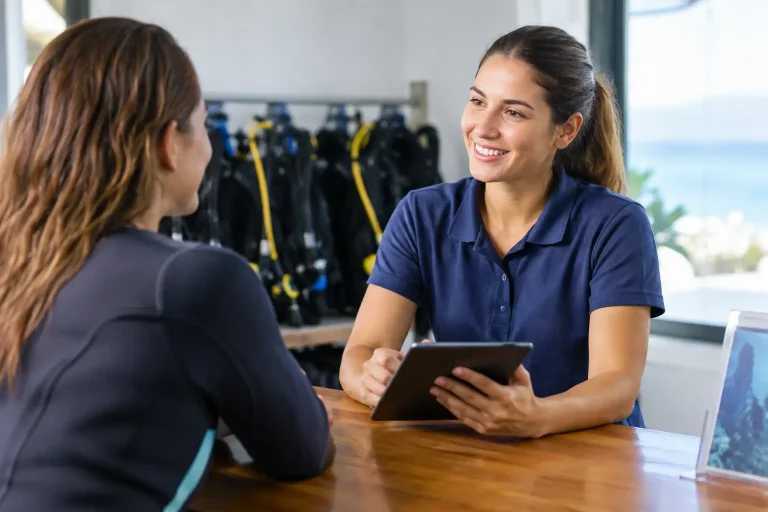
Dive instructors often lose time on communication that is necessary but repetitive. Students ask what to bring, where to meet, whether rental gear is included, what happens if conditions change, or how long the confined water session will last. None of these are difficult questions, but together they consume real operational bandwidth.
AI can help by handling routine communication quickly and consistently. Used well, that improves the student experience before training even begins. Faster answers reduce drop-off, reduce confusion, and set a more professional tone around the course.
For dive centers and freelancers alike, this is not just about convenience. Good communication improves preparedness. Prepared students arrive with the right expectations, the right equipment, and fewer last-minute misunderstandings. That contributes directly to smoother training days.
Still, not every message should be automated. Questions about medical concerns, training readiness, anxiety, or course performance need human attention. The best model is selective use: let AI handle high-frequency logistics and route the sensitive, safety-relevant, or judgment-based conversations to an instructor.
Administrative support that protects instructor time
A significant share of instructor fatigue comes from tasks that happen around the course rather than inside it. Scheduling, reminders, documentation follow-ups, student onboarding, and post-course engagement all take time. In smaller operations, one person may be teaching in the morning and doing admin late at night.
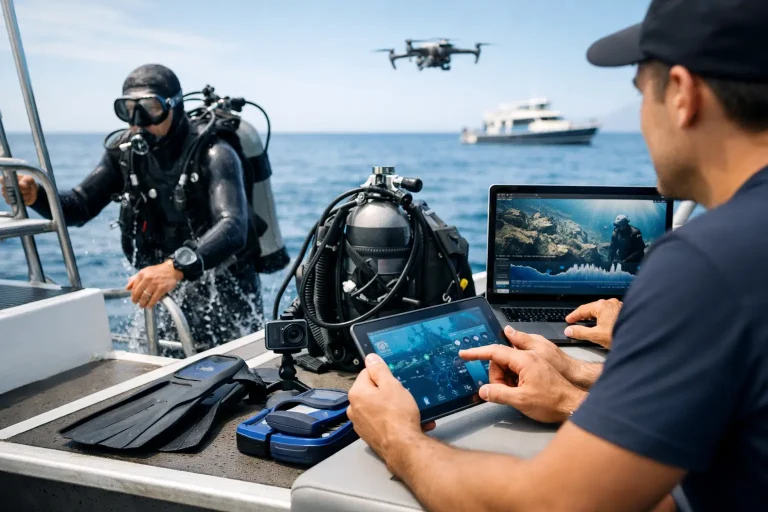
This is where AI becomes part of operational infrastructure rather than just a chatbot. It can help draft reminders, organize student records, flag incomplete forms, prepare pre-course information, and support follow-up sequences after training. If connected to a dive center’s broader workflow, these systems can reduce avoidable errors and make the customer journey more consistent.
That matters because inconsistency is expensive. It leads to missed arrivals, forgotten documents, low review completion, and weaker retention for continuing education. Instructors should not have to spend expert time fixing preventable communication gaps.
This is also why specialized diving tools matter more than generic software. Diving has its own vocabulary, risks, prerequisites, and compliance expectations. A system designed for restaurants, fitness classes, or generic education will usually miss details that matter in dive training.
Personalized learning at a practical level
Not every student needs the same support. Some are confident in theory but nervous in the water. Others are calm underwater but struggle with tables, planning, or terminology. Good instructors already adapt to this. AI can make that adaptation more scalable.
A useful application is targeted practice. If a student repeatedly misses pressure-volume questions or struggles with no-decompression concepts, AI can generate additional exercises around that exact gap. If another student is preparing for Rescue or Divemaster training, AI can help surface more advanced review material based on their stage of development.
This does not mean every course should become hyper-customized software-driven instruction. Group teaching still has value, and standardization is a major part of safe training. But there is room between one-size-fits-all and fully individualized coaching. AI can help instructors operate in that middle space more effectively.
Accessibility and language support
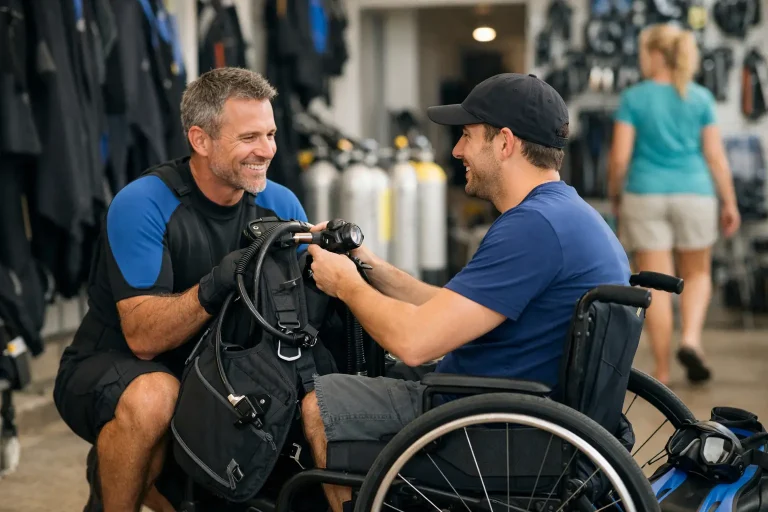
The diving industry serves an international and highly varied learner base. Students may be non-native English speakers, neurodivergent learners, older adults returning to education, or people who need information presented more clearly and with less jargon.
AI can help instructors improve accessibility by rephrasing material, simplifying language without losing accuracy, and offering alternative formats for review. That can make dive education more inclusive and reduce the gap between a student’s ability to dive safely and their comfort with formal instructional language.
This benefit deserves more attention than it usually gets. Accessibility is not a side issue. It affects who feels welcomed, who progresses confidently, and who leaves training with genuine understanding rather than memorized phrases. For an industry that wants to grow responsibly, better educational access is a strategic priority.
The limits matter as much as the benefits
Any serious answer to how can AI help dive instructors also has to be clear about where AI should stop.
AI should not make certification decisions. It should not override agency standards, local procedures, or instructor judgment. It should not be treated as a substitute for direct supervision, skill evaluation, or emergency readiness. And it should not generate false confidence just because it sounds convincing.
There are also data and trust issues. If dive professionals use AI tools that handle student information, medical context, scheduling data, or training history, privacy and system reliability matter. The industry should not accept black-box tools casually, especially when safety-adjacent operations are involved.
The right approach is augmentation, not replacement. AI should make instructors more available, more organized, and better supported. It should not distance them from students or reduce the seriousness of professional responsibility.
What good implementation looks like
The most effective use of AI in diving will be quiet and practical. It will show up in better-prepared students, cleaner communication, stronger theory retention, and less instructor burnout. It will fit into real workflows instead of forcing dive businesses to rebuild everything around a trend.
That is especially important in an industry where many professionals are still working with fragmented systems, paper processes, and digital tools that were never built for diving in the first place. AI creates value when it is part of a broader modernization effort that respects safety culture and operational reality. Platforms such as Millibar’s ecosystem reflect that direction by treating education, communication, and operations as connected rather than separate problems.
For instructors, the real opportunity is not to become more automated. It is to become more effective. If AI removes repetitive friction, supports better learning reinforcement, and helps centers run with greater consistency, then instructors can spend more of their time where it counts most: building competent, confident divers who trust the training they received.
The future of dive instruction should still be led by humans. It should just be supported by better tools.