When Should Divers Use Nitrox?
A diver signs up for two boat dives, both planned around 60 to 80 feet, then adds an afternoon reef dive because conditions are too good to waste. That is usually the moment the question stops being academic: when should divers use nitrox, and when is regular air still the better call?
The short answer is that nitrox makes the most sense when a diver wants more no-decompression time, lower nitrogen loading, or a larger safety margin on dives that stay well within the gas’s maximum operating depth. But the useful answer is more nuanced. Nitrox is not a performance gas in the broad sense, and it is not automatically the right choice for every profile, every diver, or every operation.
When should divers use nitrox on real dives?
Divers should use nitrox when the dive profile is limited more by nitrogen exposure than by oxygen exposure, gas volume, cost, or logistics. In recreational diving, that often means moderate-depth dives, repetitive dives, multi-day dive travel, training schedules with frequent water time, and any scenario where reducing inert gas load adds practical value.
For many certified recreational divers, the most obvious use case is the second or third dive of the day. If the depth remains moderate, enriched air nitrox can reduce nitrogen uptake compared with air. That can extend no-decompression limits or, just as valuable, allow the diver to keep the same bottom time with a wider margin.
That distinction matters. Many experienced instructors and dive operators prefer to frame nitrox as a conservatism tool rather than a way to chase longer bottom times. Used that way, it supports better risk management without changing the basic discipline of the dive.
The main situations where nitrox is worth using
Repetitive diving is the clearest example. On a liveaboard schedule or a resort week with three or four dives a day, nitrogen accumulation becomes operationally significant. Nitrox can help divers stay within comfortable exposure limits over several days of diving, especially when profiles are moderate rather than deep.
It also makes sense for photographers, guides, and instructors who spend long periods in the water at depths where no-decompression limits become relevant. A 50- to 70-foot profile may not sound aggressive, but repeated across a workweek, exposure adds up. In those settings, nitrox is often less about convenience and more about sustainable practice.
Training can be another good fit. Advanced classes, buoyancy workshops, and guided specialty dives often involve multiple descents, ascents, skill repetitions, and surface intervals that are not especially long. If the dive plan stays within oxygen limits, nitrox can provide useful flexibility.
There is also the fatigue conversation. Some divers report feeling less tired after diving nitrox. The science and anecdotal experience do not always align neatly, and fatigue after diving can come from many factors including hydration, workload, thermal stress, seasickness, and travel. So nitrox should not be sold as a cure-all. But in operational reality, many divers and professionals prefer it on intensive dive schedules because it supports a more conservative gas strategy.
When nitrox is not the right choice
Nitrox is not always better than air. If the planned dive is deep enough that oxygen partial pressure becomes the primary constraint, enriched air can reduce options rather than expand them.
This is where newer divers sometimes misunderstand the trade-off. Nitrox contains a higher percentage of oxygen than air, which means a shallower maximum operating depth for any given mix. On an EAN32 fill, for example, the MOD at a PO2 of 1.4 is around 111 feet. For EAN36, it is shallower still. If the dive may approach or exceed those limits, air or another appropriately planned gas may be the correct choice.
Nitrox may also be unnecessary for shallow, single dives where no-decompression time is already generous and surface intervals are long. In that case, paying extra for enriched air may not deliver meaningful value. The right gas is not the one with the most marketing appeal. It is the one that fits the profile.
There are also practical constraints. Not every dive center has consistent nitrox blending capability, analyzer workflow, labeling discipline, or digital recordkeeping around gas management. That matters because nitrox only improves safety when analysis, confirmation, and planning are done correctly. A modern operation should treat gas verification as a structured process, not an informal assumption.
Depth, oxygen exposure, and planning discipline
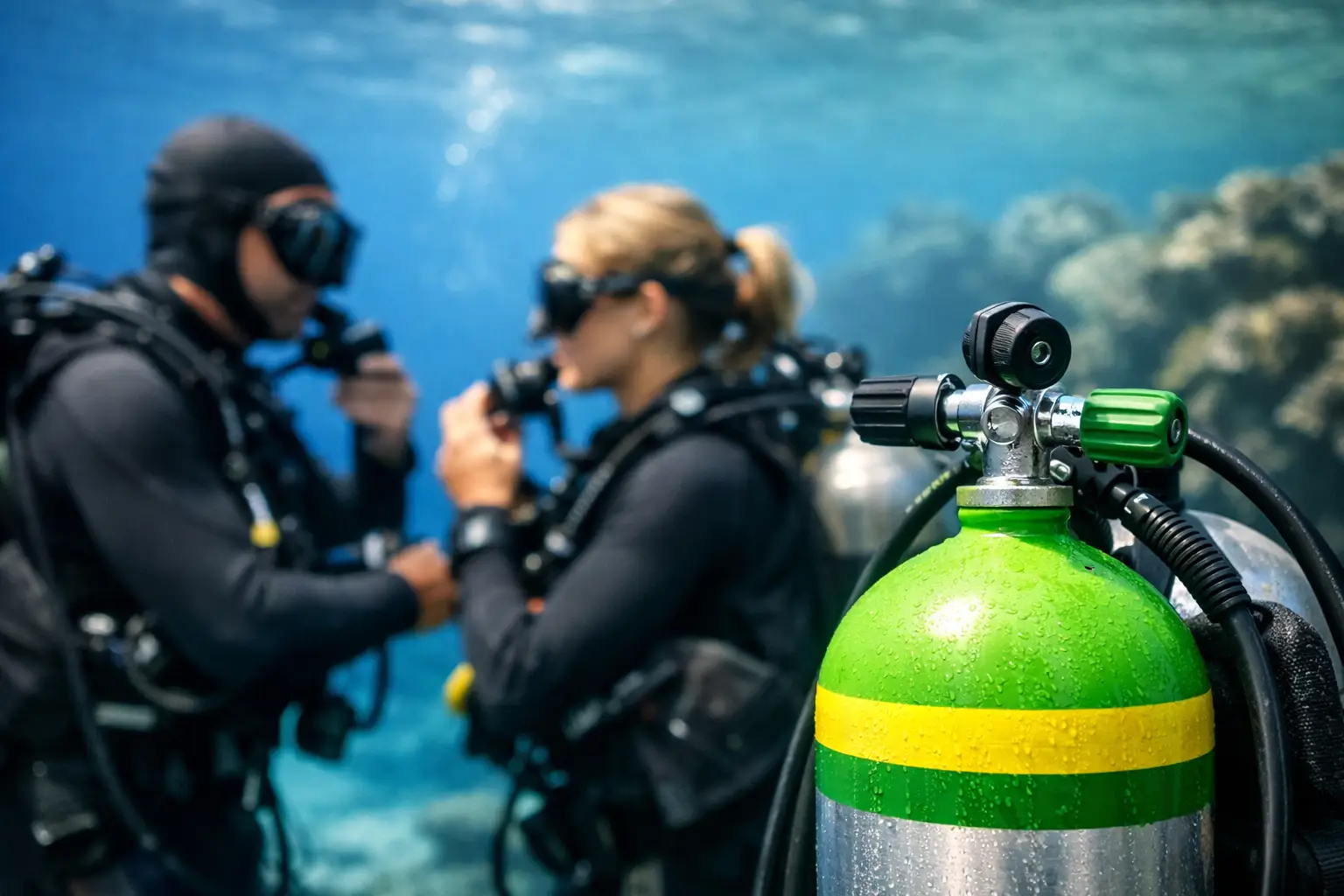
The best answer to when should divers use nitrox starts with planning, not preference. A diver should know the fraction of oxygen in the cylinder, analyze the tank personally, label it clearly, set the correct mix in the dive computer, and confirm the MOD before entering the water.
That sounds basic, but operationally it is where many preventable errors happen. A diver can be nitrox certified and still create risk by leaving a computer on air mode, assuming the fill is standard EAN32 without analysis, or joining a dive where the actual profile exceeds the gas plan.
This is one area where digital tools can meaningfully improve outcomes. Good workflows around gas analysis logs, student reinforcement, and pre-dive confirmation reduce reliance on memory and verbal handoff. In an industry where details matter, cleaner information flow is not a luxury. It is part of safety culture.
Oxygen exposure also needs to stay in view. Recreational nitrox discussions often focus on nitrogen reduction, but oxygen becomes the limiting factor at depth and over cumulative exposure. Divers need to understand both CNS oxygen exposure and the practical meaning of MODs, not just memorize a mix number from class.
When should divers use nitrox instead of air?
Divers should use nitrox instead of air when the dive remains shallow enough for the chosen mix and the operational goal is to reduce nitrogen loading or extend no-decompression flexibility. That usually means moderate-depth recreational dives, not deep profiles pushing the edge of recreational limits.
A good example is a diver doing two wreck dives around 70 feet and a third reef dive at 45 feet. If all three can be conducted comfortably within the MOD of the selected mix, nitrox may offer a real planning advantage. Another example is an instructor teaching multiple open water sessions in a week. The value there may not be dramatic on any single dive, but across repeated exposure, the margin matters.
By contrast, if the plan is a single deeper dive near the MOD of common recreational nitrox mixes, air may be simpler and more appropriate unless a more advanced gas strategy is being used by properly trained divers. Nitrox is a tool, not a default.
Certification, competency, and the operational mindset
Divers should not use nitrox without training. That is not bureaucracy. It reflects a simple reality: a gas with different oxygen content requires different planning assumptions, different computer settings, and stricter depth awareness.
The entry barrier is relatively low, which is one reason nitrox has become standard in many markets. But certification alone is not enough if the diver rarely uses it and has become rusty on MOD calculations, oxygen exposure concepts, or analyzer procedures. Competence is maintained through repetition, clear systems, and good dive habits.
For dive centers and instructors, this has a broader implication. Nitrox education should not be treated as a quick add-on card with minimal reinforcement. It works best when linked to practical planning, real dive profiles, and a visible safety workflow. That approach helps divers understand not just how to use nitrox, but when it is genuinely useful.
The bigger picture for modern dive operations
Nitrox sits at an interesting intersection of training, operations, and technology. It is common enough to be routine, but consequential enough that sloppy processes still create avoidable risk. That is exactly the kind of gap the diving industry needs to close as it modernizes.
A forward-looking dive business should be able to support gas analysis records, diver education, digital waivers, training reinforcement, and better pre-dive communication as one connected system rather than a collection of disconnected habits. That is not about replacing instructor judgment. It is about supporting it with better infrastructure.
For the individual diver, the takeaway is simple. Use nitrox when it meaningfully improves the safety margin or flexibility of the dive, and do not use it just because it sounds more advanced. The smartest gas choice is the one matched to the profile, the training, and the discipline behind the plan.
The more diving embraces that mindset, the stronger the culture becomes – not just safer on paper, but more competent in practice.