Accessible Scuba Learning Tools That Work
A student passes the confined water sessions, smiles through the checkout dives, and still blanks on partial pressure limits a month later. That gap is where real learning problems show up. In diving, access is not only about who can start training. It is also about who can retain, review, and apply knowledge when conditions change, stress rises, or time has passed.
That is why accessible scuba learning tools matter far beyond convenience. They shape how divers build confidence, how instructors reinforce theory, and how dive centers support safer, more consistent education at scale. If the industry wants stronger outcomes, better inclusion, and fewer knowledge drop-offs between classroom and water, the tools around learning need to be designed with access in mind from the start.
What accessible scuba learning tools really mean
In diving, accessibility is often reduced to a narrow compliance question. Can someone open the content, read the screen, or complete the module? Those basics matter, but they are only the beginning. Truly accessible scuba learning tools reduce unnecessary friction for a wide range of learners, including students with visual, hearing, motor, cognitive, language, and attention-related differences. They also support divers dealing with ordinary real-world constraints such as inconsistent internet, aging eyes, limited study time, or learning theory in a second language.
That broader view changes how we evaluate educational products. A PDF manual may technically contain the right information, yet still be hard to navigate on a phone, difficult for screen readers, or poorly suited to spaced review. A polished app may look modern, yet rely on tiny tap targets, low-contrast design, or jargon-heavy explanations that create their own barriers. Accessibility is not a visual layer added after development. It is a learning design decision.
For diving specifically, accessibility has another dimension: safety relevance. If a learner cannot easily revisit gas laws, buoyancy principles, decompression concepts, or nitrox procedures when needed, the cost is not just frustration. It can become poor judgment underwater.
Why the diving industry needs better learning infrastructure
Scuba education still depends heavily on fragmented formats. Students move between printed materials, instructor briefings, agency platforms, handwritten notes, messaging apps, and memory. Some learners do fine in that environment. Many do not.
The issue is not that traditional instruction has no value. Good instructors remain central to diver development, and no app should pretend otherwise. The issue is that the surrounding infrastructure is often weak. Knowledge reinforcement tends to be episodic instead of continuous. Review tends to happen before an exam rather than after certification. Accessibility tends to be treated as an exception rather than a baseline expectation.
This affects business performance as well as education. Dive centers invest significant time answering repeat theory questions, clarifying course logistics, and compensating for gaps left by disconnected systems. Instructors work around tool limitations instead of benefiting from tools built for their actual teaching environment. Students who could become engaged, long-term divers sometimes disengage because the learning experience felt harder than it needed to be.
Better learning infrastructure does not replace standards or instructors. It supports them.
The features that make accessible scuba learning tools effective
The strongest tools do not only deliver content. They help learners return to it, understand it in different formats, and apply it under realistic constraints.
Clear mobile-first design
A large share of review happens on phones, not desktops. That matters because many scuba learners study in short sessions between work, travel, and dive days. If a tool is difficult to use on a small screen, accessibility drops immediately. Clean navigation, readable typography, high contrast, and simple interaction patterns are not cosmetic improvements. They determine whether review actually happens.
Multiple ways to engage with the same concept
Some learners absorb best through short explanations. Others need diagrams, quizzes, repetition, or scenario-based prompts. An accessible tool does not assume one format works for everyone. It offers more than one path to understanding without making the experience cluttered.
This is particularly useful in scuba theory, where abstract topics can become sticky fast. Pressure, buoyancy, gas absorption, and oxygen exposure limits often make more sense when learners can move between concise theory, applied examples, and quick self-checks.
Low-friction repetition
Learning in diving should not end at course completion. Memory fades, especially for infrequently used knowledge. Accessible tools support spaced review through short quizzes, reminders, revisit-friendly modules, or targeted practice. This approach helps recreational divers retain core safety concepts and gives professionals a practical way to keep knowledge sharp.
Language clarity without oversimplification
Diving includes technical language, and some complexity is necessary. But many educational materials confuse precision with density. Good tools explain terms clearly, keep sentence structure manageable, and reduce unnecessary cognitive load. That helps newer divers, multilingual users, and experienced divers reviewing advanced topics after time away.
Compatibility with assistive needs
Screen-reader support, captions, keyboard navigation, scalable text, and thoughtful color use all matter. So does avoiding interactions that depend on speed, fine motor precision, or visual cues alone. In an industry serious about inclusion, these should be part of product requirements, not optional enhancements.
Accessible scuba learning tools in real instruction settings
The practical value becomes clearer when we look at how these tools fit into actual diving education.
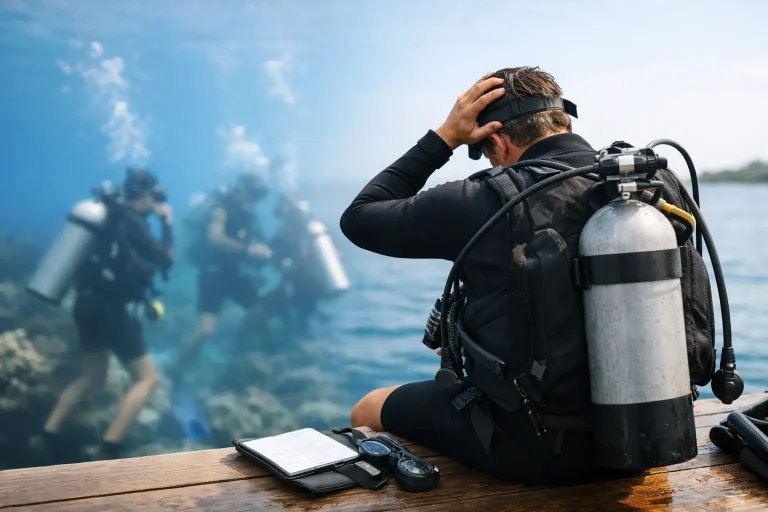
For entry-level students, accessibility often means reducing overload. New divers are managing equipment, terminology, procedures, and anxiety at once. A tool that lets them review mask equalization, hand signals, or pressure concepts in short, repeatable segments can reduce stress before the next session.
For advanced and specialty training, the need shifts. Learners may need faster recall of specific concepts such as gas planning, oxygen exposure, narcosis awareness, or decompression theory. Here, accessibility is about precision and retrieval. Can they quickly find the relevant explanation? Can they test themselves without restarting an entire course?
For instructors, accessible tools help standardize reinforcement without flattening teaching style. An instructor can still teach with personal examples, local context, and judgment while using digital learning support to close common knowledge gaps. That saves time and can improve consistency across cohorts.
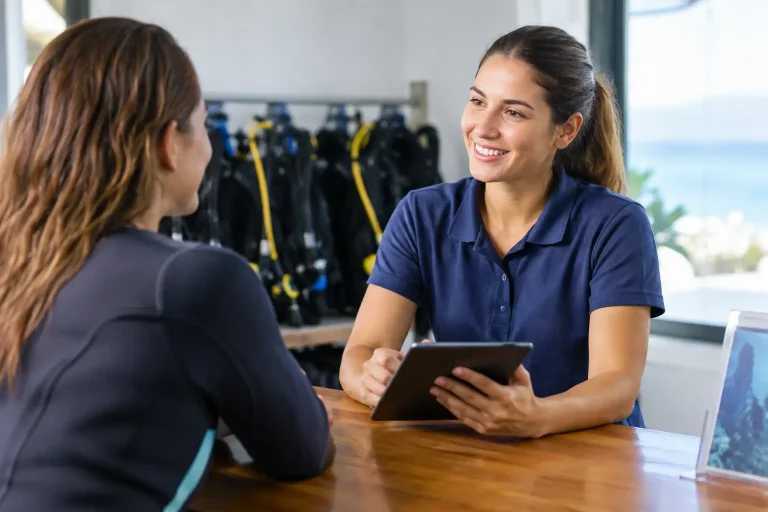
For dive centers, the gain is operational as well as educational. When students can access clear pre-course preparation and post-course review, staff spend less time repeating basic information and more time supporting actual progression. Better tools can also extend the relationship beyond the certification event, which matters in a business built on retention and trust.
The trade-offs and limits
Not every digital tool improves learning just because it is available on a screen. Some products create a false sense of mastery through shallow multiple-choice repetition. Others are so feature-heavy that the learning path becomes harder to follow. Accessibility can also be compromised when teams prioritize speed of release over testing with real users.
There is also a balance to strike between simplification and rigor. Diving is a safety-critical activity. Educational tools must make concepts easier to access, not less accurate. The goal is not to remove complexity from scuba education. It is to remove unnecessary barriers around that complexity.
And digital access does not solve every problem. In-water skill quality, instructor judgment, and local conditions still shape outcomes in decisive ways. Accessible learning tools are part of the system, not the whole system.
What the next generation should look like
The future of accessible scuba learning tools is not a bigger content library. It is a more connected, responsive learning environment built for the realities of diving.
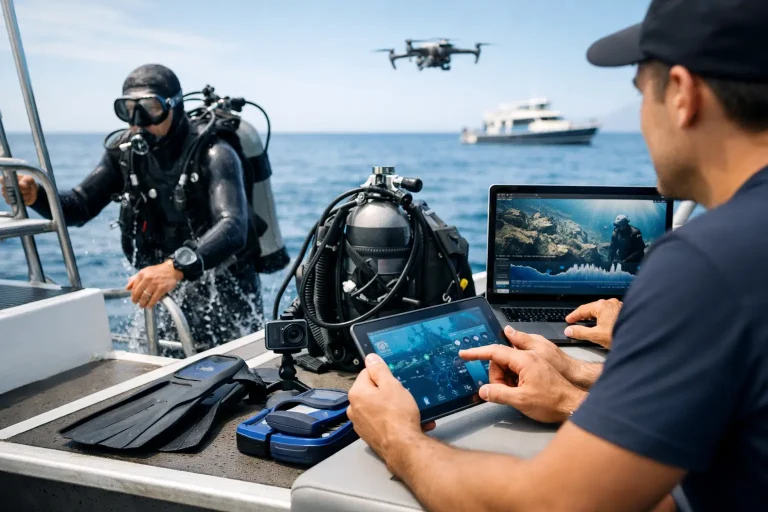
That means tools that understand where the learner is in their journey and adapt review accordingly. It means practical integrations between education, operations, and communication so students are not bouncing across disconnected platforms. It means AI used carefully to support clarification, revision, and workflow, while keeping human oversight where safety and instruction demand it.
It also means designing for the full diving ecosystem. Recreational divers need confidence and continuity. Instructors need reinforcement tools that fit real teaching. Dive centers need systems that reduce friction rather than adding one more dashboard. A purpose-built ecosystem can do this far better than generic education software retrofitted for diving later.
This is the larger opportunity for the industry. Accessibility should not be treated as a niche feature for a small subset of users. It is a quality standard that improves learning for almost everyone. When digital products in diving are built around clarity, reinforcement, inclusion, and operational fit, they raise the floor for the entire market.
At Millibar, that principle shapes how learning and operational tools should evolve together. The strongest digital products in diving will not simply digitize manuals or automate messages. They will make knowledge easier to reach, easier to retain, and easier to apply when it matters most.
If the industry wants better divers, better instruction, and better long-term participation, accessible learning cannot stay on the margins. It needs to become part of the core infrastructure we build next.